
Le Product Manager serait-il un profil d’exception ?
Le profil de Product Manager nécessite t-il vraiment des personnes exceptionnelles ?
Pour les lecteurs pressés, la réponse est : oui ! Ce rôle requiert des personnes exceptionnelles au sens statistique (et d’ailleurs, aussi souvent, sur le plan humain et professionnel).
En effet, le Product Management nécessite une combinaison de caractéristiques et de talents particuliers, qui se trouvent rarement réunis en une même personne.
Je vais développer ces points dans la suite de l’article.
Pour rappel, un Product Manager a des champs d’intervention vastes et divers (voir un résumé du rôle de Product Manager ici).
Avoir une hauteur de vue pour comprendre l’ensemble
Le Product Manager décline les objectifs stratégiques de l’organisation au niveau du produit, puis dans chaque arbitrage jusqu’aux décisions d’implémentation.
Il va ainsi découvrir, co-construire, inventer comment le Produit peut incarner la vision et porter les objectifs stratégiques de l’entreprise.
Cette activité d’affinage, itérative et constamment revue, va du dégrossissage fonctionnel et technique des thèmes ou epics, jusqu’à l’affinage des User Stories positionnées à courte ou moyenne échéance.
Ce travail couvre un large spectre de compétences : analyse, compréhension profonde des besoins, capacité d’écoute véritable, conception et consolidation avec les différents acteurs, et bien sûr capacité de partage et de formalisation.
Par exemple : comment projeter le découpage temporel de création de valeur ? A quel moment les utilisateurs (ou clients) vont-ils accéder à telle ou telle fonctionnalité ? Quelles seront les releases majeures ? Comment sont addressés les jalons temporels ? Des Story Maps et de Roadmaps (au niveau Portefeuille et Produit) peuvent par exemple adresser ces questions.
Le vrai challenge du Product Manager n’est pas de produire ce découpage, mais que ce découpage maximise la valeur délivrée.
Il ne s’agit donc pas de maîtriser quelques techniques, mais de pouvoir les adosser sur une grande clairvoyance et une grande agilité intellectuelle. Cela permet de décoder les forces en présence et le marché, d’y intégrer habilement les paramètres pratiques, en cohérence avec l’ensemble du tableau, tel que visible ou émergeant en filigrane.
Cette analyse subtile guidera aussi l’arbitrage des priorités.
Garder en tête que le diable est dans les détails
Certains peuvent être tentés de déléguer à des experts la définition détaillée des User Stories ou la recette. Le risque est de perdre de vue ces “détails”, qui se révèleront, au final, souvent différentiateurs.
Une bonne idée de produit n’est rien sans sa matérialisation réussie.
Cela nécessite souvent de comprendre en profondeur des éléments paraissant, vus de haut et de loin, comme des détails.
Or, du point de vue utilisateur, ce ne sont pas des détails. Ce peut même être des critères implicites d’adoption du produit. Par exemple, la fluidité de l’expérience utilisateur, la facilité de saisie assistée, la sauvegarde automatique, etc.
La contribution précieuse des différents experts (UX, etc.) ne devrait donc pas être une occasion pour le Product Manager de se déconnecter de l’expérience sensible de son produit.
Savoir capter les signaux du terrain
Un bon produit est donc d’abord celui qui coche les cases sur le terrain, dans ses aspects pratiques qui s’avèrent importants à l’usage.
Il peut être difficile pour le Product Manager, exposé aux enjeux stratégiques et à de fortes pressions, de consacrer le temps et l’attention nécessaires à certains détails d’implémentation.
Cette qualité d’écoute nécessite, outre de la disponibilité, une forte capacité à distinguer les détails critiques parmi le reste. Il s’agit d’entendre et attraper les détails potentiellement impactants parmi les feedbacks techniques ou terrain (utilisateur, support, etc).
Le bon Product Manager est donc ancré : il reste sensible aux signaux proches ou lointains.
A ce titre, son animal totem pourrait être l’éléphant, qui perçoit des signaux subtils jusqu’à 30 kilomètres (la surface très sensible de la plante de leurs pattes détecte des vibrations à basse fréquence).

Le Product Manager, profil faisant figure d’excellence dans ces deux dimensions opposées
Trouver un profil capable d’analyser au niveau conceptuel et global comme de décliner les détails pratiques est plutôt aisé.
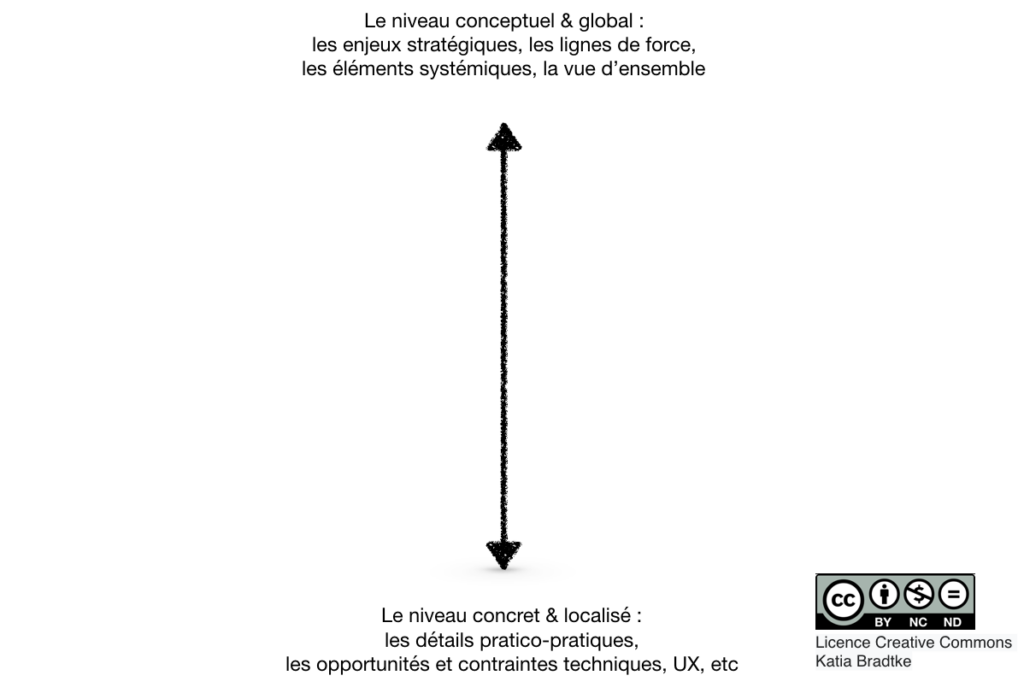
Mais ce dont a besoin l’entreprise ici, ce n’est pas juste un travail correct, mais véritablement d’un travail de haut niveau, nécessitant a minima un engagement intellectuel plénier.
En effet, l’enjeu est la création de valeur de l’entreprise !
Chaque acte de Product Management impacte la capacité à générer :
– du revenu (pour une entreprise commerciale)
– et/ou de l’utilité valorisable (pour une organisation financée par d’autres sources que la monétisation de produits et services).
Le Product Management n’est pas une fonction parmi d’autres : c’est un investissement qui produit des effets durables, et dont dépendra la survie et la croissance de l’entreprise.
Un couplage fort du Product Manager avec les développeurs
Cette capacité à relier les enjeux globaux avec des arbitrages techniques concrets se manifeste dans la relation construite avec l’équipe de réalisation. Il faut savoir partager les enjeux avec les développeurs (et autres experts réalisant le produit) sur le produit, les jalons, etc. Lors de ce partage, le Product Manager sait alors aussi écouter les feedbacks et les besoins techniques.
Les qualités de communication du Product Manager sont fondamentales pour créer une relation collaborative durable, basée sur le respect et la loyauté.
Si tous les membres de l’équipe portent cette responsabilité de “faire équipe”, dans la pratique, le Product Manager, parfois perçu comme le “client”, a un poids plus important.
Il a ainsi souvent, dans les faits, la responsabilité implicite d’insuffler cette dynamique vertueuse.
Cela nécessite des qualités morales certaines, mais également une grande solidité et des appuis (coaching, soutien interne, communauté de pratiques, etc.) ! Je développerai cet aspect dans un prochain article.
Voici pour notre conviction quant au profil d’exception requis pour le poste de Product Manager.
Et dans votre entreprise, vos Product Managers disposent-ils des soutiens et des formations nécessaires pour développer, exercer et renforcer ces compétences essentielles à leur succès ?