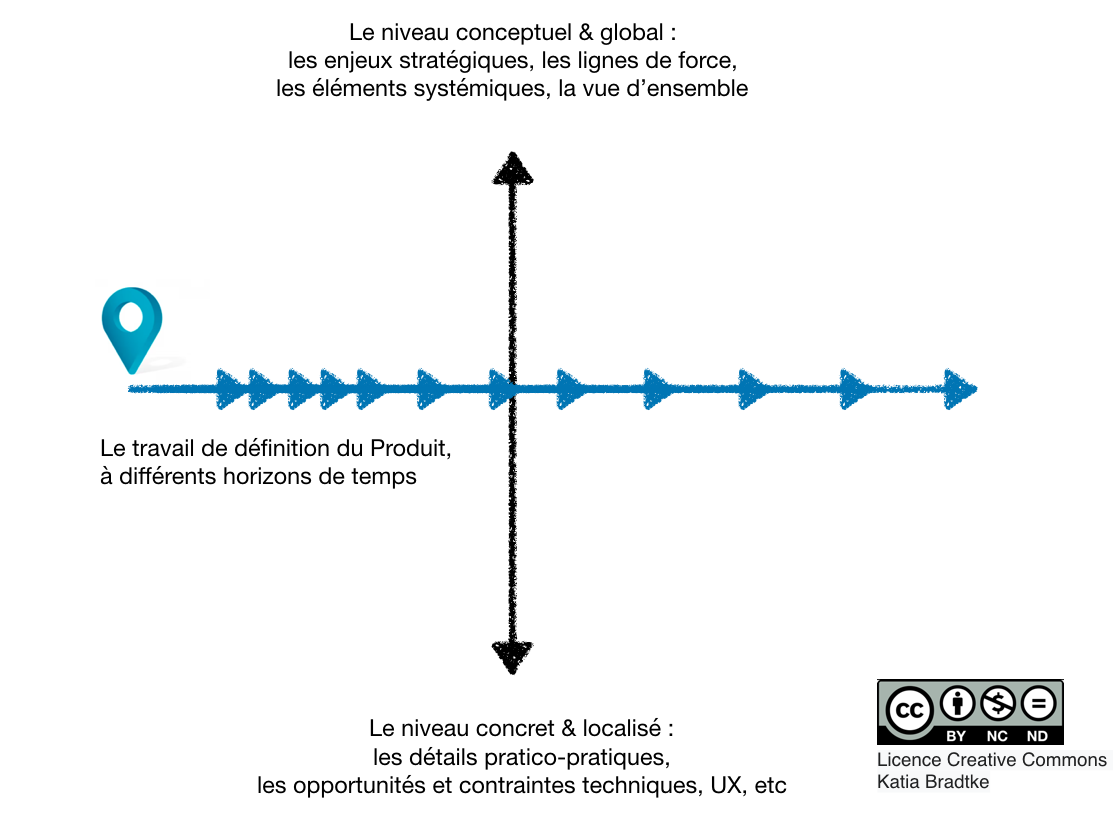
Nous décrivons dans cette série d’article en quoi le Product Management requiert des personnes exceptionnelles (au moins au sens statistique). Ce second article explore une autre dimension : la gestion des horizons temporels.
Un premier article montrait l’étendue du spectre de compétences requis pour créer une valeur produit forte, et ainsi contribuer à la pérennité et la croissance de l’entreprise. En effet, un des défis du Product Manager est d’élaborer une vision globale en gardant une compréhension sensible de “détails” différenciants pour l’utilisateur.
Gérer le présent & imaginer le futur proche et lointain
Le Product Manager doit créer une dynamique forte autour du produit, en motivant et facilitant l’implication suffisante de parties prenantes à tous les stades utiles.
Il doit intégrer dans sa réflexion produit :
- les priorités stratégiques de l’organisation,
- les caractéristiques de l’organisation (ses forces et faiblesses, actuelles et futures),
- les caractéristiques externes (les opportunités et menaces, actuelles et futures du marché, des tendances d’innovation technologique produit, etc.).
Les différents scénarios qu’il projette reposent sur des hypothèses dont certaines sont connues, et d’autres sont incertaines ou en évolution.
Malgré ces incertitudes, il doit choisir le scénario paraissant le plus réaliste et le plus porteur de valeur.
Sur cette base, qui peut évoluer (et va souvent évoluer), le Product Manager structure les futures contributions et feedbacks des parties prenantes, pour concevoir un produit satisfaisant et innovant.
Il lui faut donc imaginer : qui faire contribuer ? quand ? sur quel sujet ? tout en gérant les dépendances conceptuelles de la réalisation produit.
Il est crucial de mobiliser ces parties prenantes suffisamment tôt, sans surdimensionner cette sollicitation, car cela pourrait rendre leur disponibilité difficile. Le Product Manager doit donc anticiper et prévoir les ateliers bien à l’avance, dès le démarrage du projet
Or, c’est précisément à ce moment que la visibilité est la moins bonne et l’incertitude maximale (voir le cône d’incertitude décrit ici). En effet, il ne dispose pas encore de toutes les informations nécessaires, ni de certitudes sur certains aspects du produit.
De plus, le Product Manager doit détecter par avance les probables besoins de maturation.
Ces temps de maturation peuvent aussi varier : par exemple, certains sujets nécessiteront plusieurs ateliers (pour s’imprégner, partager, s’aligner, etc) avec des temps de décantation intermédiaires spécifiques, alors qu’un simple atelier suffira pour d’autres sujets.
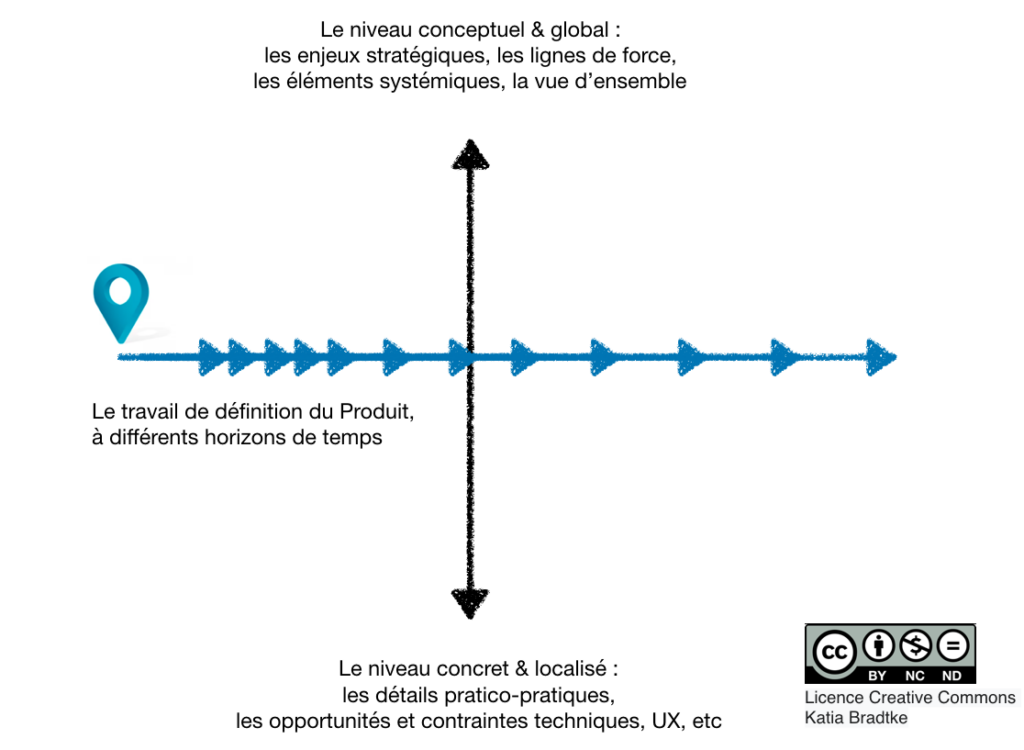
Le prochain article détaillera ce défi, démultiplié quand il est combiné aux différents horizons temporels.
Gérer le cycle de vie pour maximiser le ROI
Enfin, le Product Manager doit avoir une vision long terme et globale du cycle de vie du produit. Pour maximiser le ROI, il compare différents scénarios de cycle de vie Produit.
Il s’agit de définir les horizons d’investissement pour un produit ou une gamme de produits. Les revenus et les coûts associés sont à considérer sur la durée de vie du Produit.
Une erreur fréquente au dimensionnement budgétaire est de se focaliser sur le coût de création du Produit (la phase dite de « Build »). La raison généralement avancée est que le Run et le Build sont deux lignes budgétaires distinctes.
Or, le ROI d’un produit dépend bien de son coût global, soit l’addition des coûts de Build et de Run.
En effet, pendant la durée de vie Produit, d’autres coûts s’ajoutent et sont potentiellement difficiles à maitriser. Ces coûts subis sont notamment ceux du maintien en condition opérationnelle (maintenance, support, migration technique). De la même façon, la budgétisation devrait intégrer les coûts de décommissionnement et de réversibilité.
L’objectif du Product Management est de prévoir l’ensemble des investissements pour maximiser la rentabilité globale et durable du produit.
Savoir servir le présent sans desservir le futur
A côté de cette vision globale du budget, un autre élément impacte la maitrise du budget Produit.
En effet, le Product Manager doit arbitrer quantité d’options Produit (sur le périmètre, sur l’implémentation, etc). Or, il y là un pattern récurrent : l’opposition entre l’intérêt du jour, tangible, et la création de valeur à moyen ou long terme (par exemple avoir un produit maintenable et évolutif).
Quand l’enjeu immédiat est pressant (vendre plus de licences, pénétrer tôt un marché, démo sur un salon, etc), il est tentant d’hypothéquer la lointaine création de valeur à long terme.
Cette situation type conduit alors à la solution de bricoler rapidement quelque chose qui répond au besoin. Bien entendu, c’est provisoire. On se promet de mettre au carré ce bricolage temporaire, dès que le coup de feu sera passé.
De mon expérience (et de celle des autres coachs agiles de Smartview), ce provisoire peut être retrouvé, tel quel, plusieurs années après.
Concrètement, le provisoire implique généralement une solution insuffisante du point de vue de la qualité. Par exemple : failles de sécurité, inmaintenabilité (variables en dur, code windev dans des boutons, absence de documentation), problème de performance, verrue incohérente avec le reste de l’application, etc.
Pour rappel, les coûts de la phase Run sont indexés sur la qualité du Produit.
Les gains immédiats sont donc dépassés, parfois de très loin, par les surcoûts de cette solution dite temporaire, et devenue, dans les faits, un élément de l’application.
Cet article illustre les aventures de la dette technique.
Un bon arbitrage intègre donc cette vision globale pour préserver la valeur sur toute la durée de vie du Produit. Il faut donc parfois résister à la tentation de raccourcis vers le gain immédiat (time-to-market, richesse fonctionnelle, ..) pour un gain global meilleur.
Conclusion
Le Product Manager joue un rôle crucial en projetant des scénarios futurs à divers horizons temporels malgré les incertitudes présentes. Il collecte et décode tous les inputs pour appréhender la situation (actuelle ou émergente en filigrane).
Cette capacité à naviguer entre le présent et le futur, tout en mobilisant et motivant les parties prenantes, fait du Product Management un art difficile. Dans le prochain article, nous explorerons cette complexité liée au parties prenantes et aux horizons temporels
Cela explique pourquoi investir dans le Product Management, en formant et en soutenant ces professionnels, est essentiel pour toute organisation voulant rester compétitive.
Et vous, comment votre entreprise forme, coach et soutient ses Product Managers ?